
DEX арбитраж
DEXTrack DEX to CEX spreads, CEX volume, liquidity quality, and hedge-ready arbitrage routes across major crypto venues.
Scanner
Live route candidatesПроверка доступа...
DEX Arbitrage Guide: DEX to CEX, DEX to Futures, and On-Chain Spread Strategies
Learn how to trade DEX arbitrage with real execution logic: buy on a decentralized exchange, hedge or exit on a centralized exchange, validate liquidity, control gas, and close when the spread converges. This guide covers DEX to CEX transfers, DEX to futures hedges, same-chain DEX spreads, and fast momentum dislocations where on-chain price moves before CEX reacts.
Что такое DEX-арбитраж?
DEX-арбитраж — это использование разницы цен между ончейн-рынками и офчейн-рынками до того, как спред полностью схлопнется. Самые сильные сетапы обычно приходят из DEX → CEX переводов, покупки на DEX с шорт-хеджем через фьючерсы, same-chain DEX → DEX дисбалансов и быстрых ончейн-импульсов, когда централизованные котировки еще не успели обновиться.
Наш DEX scanner помогает оценивать не только красивый спред, но и реальное качество исполнения. Вы можете сравнивать качество маршрута, ликвидность, торговый flow и глубину выхода, а затем использовать Telegram alerts или API, чтобы держать исполнение быстрым и системным.
Pro Workflow
Держите сканер и алерты в одном цикле
Следите за спредами, проверяйте качество маршрута и только потом запускайте Telegram alerts с отдельной логикой для spot и futures, чтобы сигналы оставались исполнимыми в быстрых движениях рынка.
Binance, Gate, OKX, Bybit, KuCoin, MEXC и другие биржи для spot-выходов и hedge-ног.
Проверяйте, можно ли еще реально исполнить маршрут: сравнивайте ликвидность пула, свежесть котировки и то, насколько чисто можно выйти на богатой стороне.
Используйте scanner для мониторинга спредов, Telegram alerts для быстрой реакции и API, если хотите встроить DEX-маршруты в свою систему.
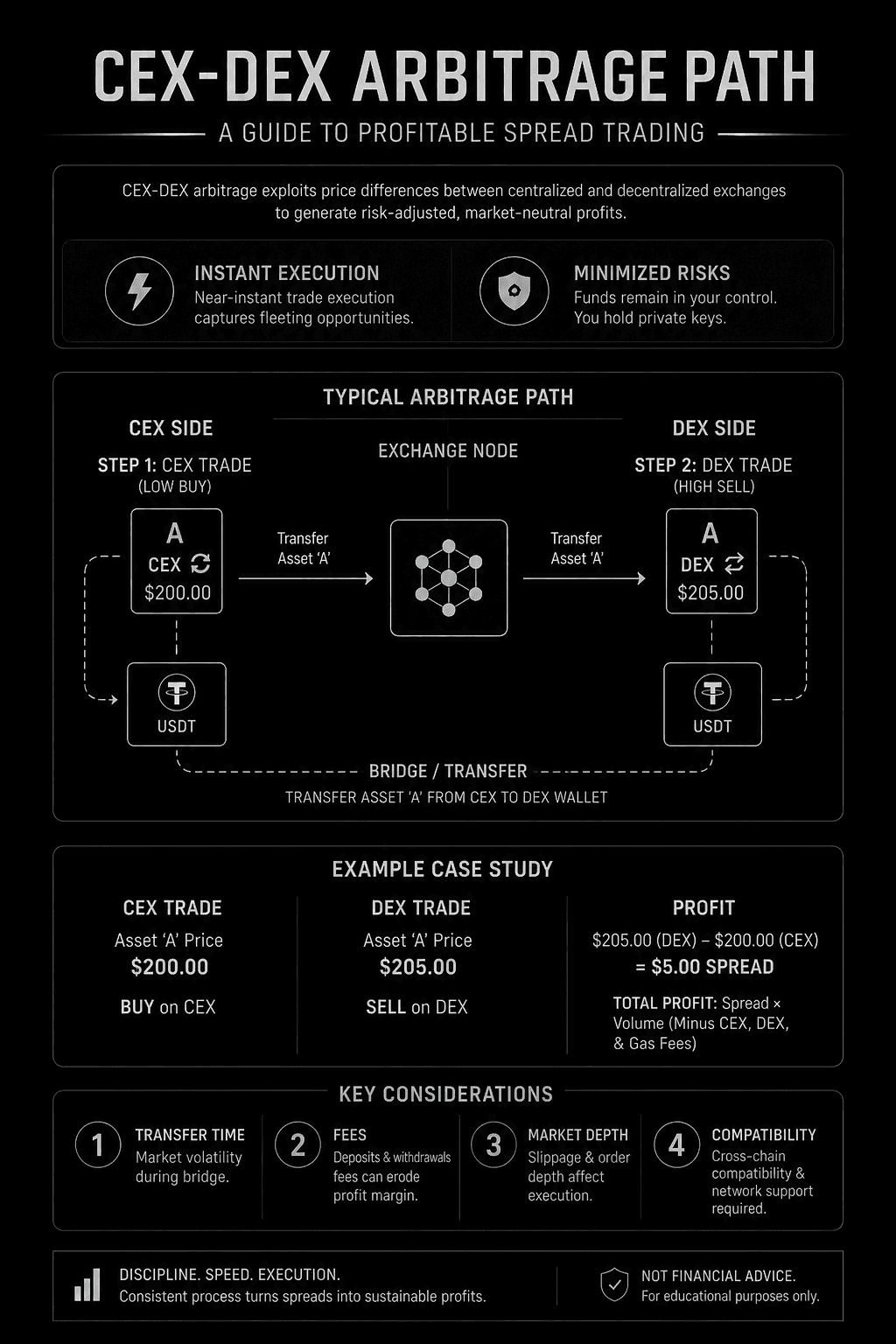
How the DEX scanner finds spreads across 20+ CEX venues
Price comparison layer
The scanner compares on-chain routes to centralized quotes from major venues, then ranks setups by spread quality instead of only raw price difference.
Execution quality layer
Liquidity, buy/sell flow, market cap, quote age, and CEX volume help remove fake spreads that collapse as soon as you try to trade them.

Transfer-style exits: validate deposit/withdraw rails and spot volume before trusting the spread.

Hedge-style setups: spread + funding + lifetime is the minimum validation set.
DEX arbitrage overview
DEX to CEX arbitrage
Buy on the cheaper DEX, move inventory or already-held inventory toward the more expensive CEX, and sell once deposit and order-book depth are confirmed. This is the most intuitive route for spot-led execution.
DEX buy plus futures short
Buy the spot token on-chain and short the richer perp or futures contract on a CEX. When the hype cools and prices converge, unwind both legs and keep the spread after gas, fees, and funding.
DEX momentum lead
Sometimes the DEX moves first because a low-float pool gets hit aggressively. If CEX price is still stale, the edge is often a fast hedge or fast exit rather than a slow transfer.
Same-chain DEX to DEX
Compare two routers or two pools on the same chain. These trades can be fast, but your slippage tolerance and route simulation need to be much tighter.
Live Example: DEX entry + CEX hedge (spot or perp)
Validate the DEX leg (liquidity + activity), then hedge or exit on a CEX while the spread compresses.
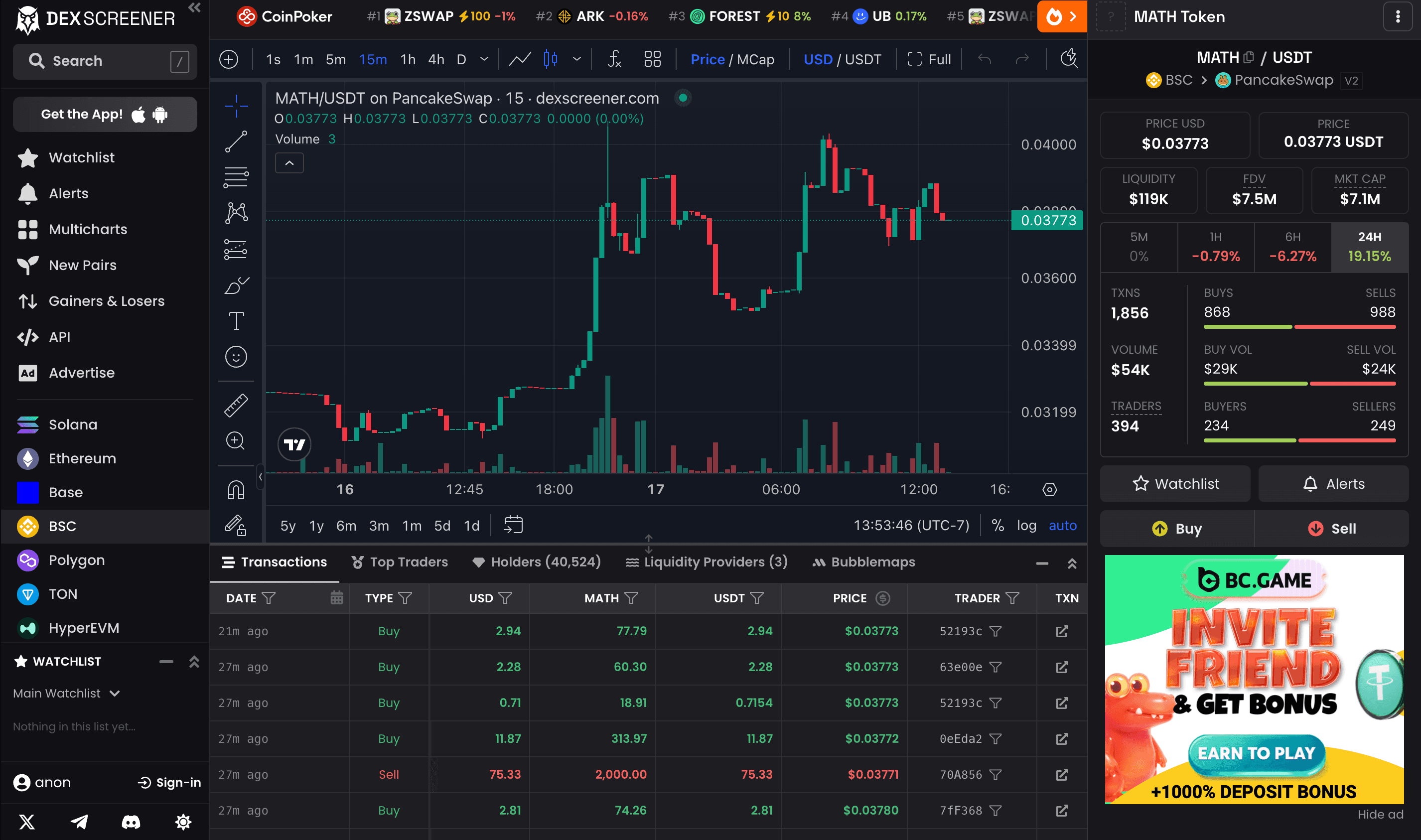
Step 1: DEX buy trigger
The DEX chart shows MATH/USDT on PancakeSwap trading around $0.03773. Before you act, confirm pool liquidity, 24h activity, and that the quote is fresh (not a thin, single-wick print).
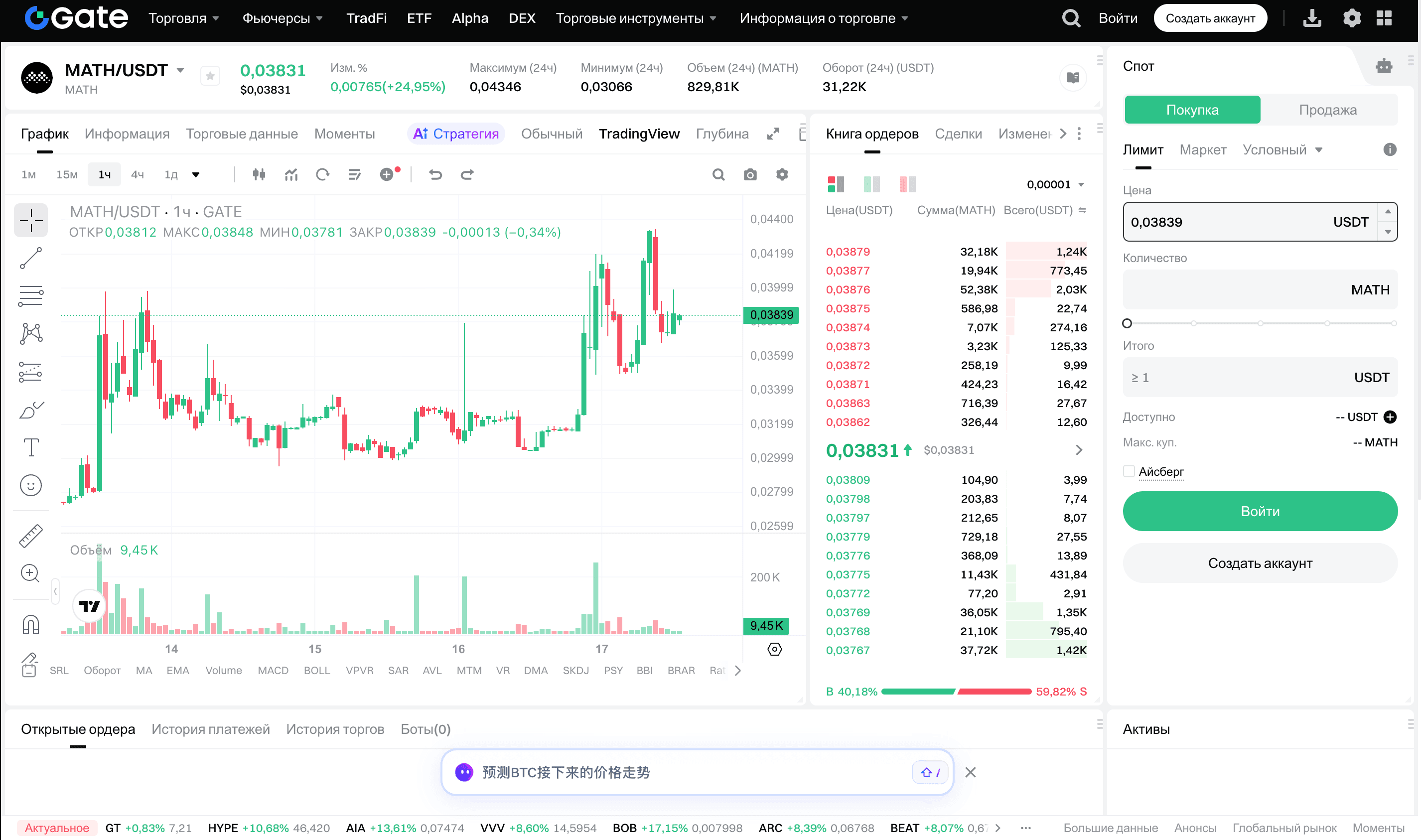
Step 2: Gate exit/hedge leg
Gate shows MATH/USDT around $0.03839. This is your rich-side validation: check order-book depth and transfer rails (if needed). If a perp is available and stays richer, you can hedge; otherwise plan a clean spot exit.
Execution summary: buy on the DEX only when liquidity and activity look real, then validate the rich CEX leg (depth + rails) and exit or hedge while the spread compresses. If liquidity thins, gas spikes, or the rich-side depth disappears, skip the setup.
DEX arbitrage strategies that traders actually use
1. DEX to CEX transfer arbitrage
Best when the DEX is clearly cheaper, withdrawal and deposit rails are open, and the token is liquid enough on the CEX to exit without killing the edge. This is slower than hedging, but easier to understand operationally.
2. DEX to futures hedge
Best when DEX spot leads and the CEX futures contract is richer. Buy on-chain, short the richer contract, then close both legs when the basis compresses. This usually beats a slow transfer in volatile names.
3. DEX momentum lead vs lagging CEX
If the pool gets hit first and CEX price has not updated yet, the opportunity is often a fast short or a quick sell into the centralized order book. These windows can be short, but they are some of the best asymmetric setups.
4. DEX to DEX same-chain spreads
Look for router mismatches across Uniswap, Curve, Balancer, Camelot, or Jupiter routes. Execution is fast, but your slippage tolerance and route simulation need to be much tighter.
Step-by-step execution checklist
Detect route imbalance
Scan chain, router, liquidity, and 24h movement to isolate spreads that still stay positive after gas and slippage.
Validate depth
Check dex buys, dex sells, pool liquidity, and market cap before committing size. Thin pools should be ignored even with a large spread.
Execute fee-aware
Use the preview route only when gas, routing cost, and quote age keep net edge positive. Requotes and stale paths kill DEX setups fast.
Track the route
Monitor whether the route is still stable. If net spread narrows, liquidity drops, or gas spikes, skip the trade and wait for a cleaner setup.
Liquidity rule
Do not size off the headline spread. Size off real exit depth, quote age, and how quickly the rich side can normalize.
Gas rule
If gas spikes enough to cut the net edge below your threshold, the setup is gone even if the raw spread still looks big.
Exit rule
Close when convergence happens, not when the chart looks exciting. Arbitrage pays on compression, not on hope.
Risk / volatility playbook for DEX spreads
When to skip
Skip if spread is old, pool depth is thin, gas jumped, or order-book depth on the rich side cannot absorb your size.
Risk filters to keep
Use min liquidity, min market cap, min buys/sells, max lifetime, and minimum CEX volume together. One filter alone is not enough.
Spot transfers: operational checks before route execution
Deposit/withdraw status
Keep deposit and withdraw checks enabled if your route depends on moving funds. A broken rail can cancel the edge instantly.
Transfer-time stop
Use a hard time-stop for transfer routes. If transfer is too slow, the spread usually converges before your exit fill.
Удобные Telegram-уведомления для DEX-арбитража
Настройте удобные Telegram-уведомления для маршрутов DEX-арбитража, хедж-сетапов и фильтров исполнения. Вы можете разделить spot-алерты для переводов и futures-алерты для хеджа, управлять частотой сигналов и оставлять только действительно полезную информацию для реального исполнения.
DEX → Spot уведомления
Гибкая настройка: выберите `spot` для маршрутов с переводом или `both`, чтобы получать спотовые и фьючерсные уведомления в одном потоке. Частота задается через `notification_interval_minutes`.
Полезные проверки исполнения: включите фильтры доступности депозита и вывода, чтобы видеть только те маршруты, которые можно реально перевести и закрыть.
Более качественные сигналы: комбинируйте список spot-бирж, объем, лимиты спреда и lifetime-фильтры, чтобы уведомления были практичными, а не шумными.
Больше информации по маршруту: используйте фильтры по DEX-сетям и пулам, чтобы сфокусироваться на знакомых площадках, сильной ликвидности и более повторяемых возможностях.
ORAIUSDT ➠ 2.3843%╼╼╼╼╼╼╼╼╼╼╼╼╼╼╼╼╼╼╼╼╼╼╼╼╼╼╼╼╼╼╼╼╼╼╼╼╼╼╼╼╼╼╼╼╼╼⌬ MARKET• DEX Liq ➠ $7,576.14• DEX 24h % ➠ -5.33% (24h)• Market Cap ➠ $5,545,036.00• CEX Vol 24h ➠ $5,248.60• DEX TX 24h ➠ 167b / 130s• Lifetime ➠ 2152s╼╼╼╼╼╼╼╼╼╼╼╼╼╼╼╼╼╼╼╼╼╼╼⌬ TRANSFER• Network ➠ ORAI• Deposit ➠ ONLINE• Withdraw ➠ ONLINE• Fee ➠ —╼╼╼╼╼╼╼╼╼╼╼╼╼╼╼╼╼╼╼╼╼╼╼
DEX → Futures уведомления
Отдельный futures-поток: используйте `futures` для хедж-уведомлений или `both`, чтобы запустить spot и futures вместе.
Контроль площадок: настройте разрешенные фьючерсные биржи вместе со строгими фильтрами по DEX-сетям и пулам, чтобы отсечь слабые рынки.
Полный контекст сигнала: оценивайте спред вместе с объемом фьючерсов, funding и lifetime маршрута, чтобы широкие, но слабые сетапы не забивали ленту.
Меньше шума: если уведомлений слишком много, сначала повысьте минимальный спред и минимальный объем фьючерсов, а уже потом увеличивайте интервал.
Что важнее всего: сначала качество площадки, затем глубина ликвидности, стабильность спреда и условия funding.
BICOUSDT ➠ 1.4458%╼╼╼╼╼╼╼╼╼╼╼╼╼╼╼╼╼╼╼╼╼╼╼╼╼╼╼╼╼╼╼╼╼╼╼╼╼╼╼╼╼╼╼╼╼╼╼╼╼╼╼╼╼╼⌬ Liquidity ➠ $38,807.13⌬ MarketCap ➠ $33,258,781.00⌬ DEX Change ➠ 8.22% (24h)⌬ DEX Activity ➠ 580b / 489s⌬ Lifetime ➠ 84s╼╼╼╼╼╼╼╼╼╼╼╼╼╼╼╼╼╼╼╼╼╼╼╼╼╼╼⚙︎ Fut Volume ➠ $12,246,491.08⚙︎ Funding 8h ➠ -0.129639%⚙︎ Type ➠ futures_to_dex╼╼╼╼╼╼╼╼╼╼╼╼╼╼╼╼╼╼╼╼╼╼╼╼╼╼╼Chart ➠ DexScreener
Best chains and venues for DEX arbitrage
DEX → CEX Transfer
Cheaper on-chain spot, richer centralized exit. Best for clean deposits, deep order books, and patient execution after confirmation.
DEX → Futures Hedge
Buy on DEX, short the richer perpetual or futures venue. Best for hype spikes, new token momentum, and faster convergence exits.
Same-Chain DEX Spread
Route mismatch between two pools or routers on the same chain. Lower transfer friction, but much tighter slippage discipline is required.

Ethereum
ETH
Best for: Deep blue-chip pools
Strength: Largest liquidity, best major-pair depth
Works well for: DEX → CEX, same-chain majors

Arbitrum
ARB
Best for: L2 spread capture
Strength: Cheap execution, strong alt liquidity
Works well for: DEX → CEX, same-chain DEX

Optimism
OP
Best for: Route arbitrage
Strength: Low fees, clean L2 settlement
Works well for: DEX → CEX, same-chain DEX

Solana
SOL
Best for: Fast momentum dislocations
Strength: Fastest execution, tiny fees
Works well for: Momentum lead, DEX → futures

BSC
BNB
Best for: Retail flow spikes
Strength: Active meme rotation, frequent CEX lag
Works well for: DEX → futures, DEX → CEX

Base
BASE
Best for: New listing momentum
Strength: Fast retail repricing, cheap routing
Works well for: DEX → futures, DEX → CEX
Why traders use a DEX arbitrage scanner
Manual monitoring is too slow once you track multiple chains, routers, and centralized exits. A proper DEX arbitrage scanner lets you rank spreads by liquidity, flow, chain, age, and execution quality instead of chasing random candles from social media.
Use the scanner to pre-filter only the setups that still make sense after gas, slippage, and exchange fees. Then use TG Alerts for route notifications and DEX API if you want to wire DEX spreads into your own stack.
TG Alerts
DEX route notifications with custom interval and venue filters
DEX chains
DEX dexId
Allowed spot exchanges
Allowed futures exchanges
ORAIUSDT ➠ 2.3843%╼╼╼╼╼╼╼╼╼╼╼╼╼╼╼╼╼╼╼╼╼╼╼╼╼╼╼╼╼╼╼╼╼╼╼╼╼╼╼╼╼╼╼╼╼╼⌬ MARKET• DEX Liq ➠ $7,576.14• DEX 24h % ➠ -5.33% (24h)• Market Cap ➠ $5,545,036.00• CEX Vol 24h ➠ $5,248.60• DEX TX 24h ➠ 167b / 130s• Lifetime ➠ 2152s╼╼╼╼╼╼╼╼╼╼╼╼╼╼╼╼╼╼╼╼╼╼╼⌬ TRANSFER• Network ➠ ORAI• Deposit ➠ ONLINE• Withdraw ➠ ONLINE• Fee ➠ —╼╼╼╼╼╼╼╼╼╼╼╼╼╼╼╼╼╼╼╼╼╼╼
BICOUSDT ➠ 1.4458%╼╼╼╼╼╼╼╼╼╼╼╼╼╼╼╼╼╼╼╼╼╼╼╼╼╼╼╼╼╼╼╼╼╼╼╼╼╼╼╼╼╼╼╼╼╼╼╼╼╼╼╼╼╼⌬ Liquidity ➠ $38,807.13⌬ MarketCap ➠ $33,258,781.00⌬ DEX Change ➠ 8.22% (24h)⌬ DEX Activity ➠ 580b / 489s⌬ Lifetime ➠ 84s╼╼╼╼╼╼╼╼╼╼╼╼╼╼╼╼╼╼╼╼╼╼╼╼╼╼╼⚙︎ Fut Volume ➠ $12,246,491.08⚙︎ Funding 8h ➠ -0.129639%⚙︎ Type ➠ futures_to_dex╼╼╼╼╼╼╼╼╼╼╼╼╼╼╼╼╼╼╼╼╼╼╼╼╼╼╼Chart ➠ DexScreener
DEX alert matrix
What each field controls
| Bot | @crypto_arbitrage_dex_bot |
|---|---|
| Trigger | DEX price leads CEX or futures price stays richer |
| Interval | 10 min |
| Primary routes | DEX → CEX, DEX → Futures, same-chain DEX → DEX |
| Exit focus | Close on spread compression, not on emotion |
Recommended setup
- 1. Use 5-10 min for fast DEX leads.
- 2. Use 30-60 min for slower transfer routes.
- 3. Keep min spread above gas + exchange fee budget.
- 4. Prefer rich CEX exits with stable order-book depth before enabling alerts.
DEX API Documentation
Open the full documentation in a separate page for endpoint reference, payload examples, response schemas, rate limits, API key usage, and SDK examples.
View Full Documentation