
Scanner
Live route candidatesVerifying access...
DEX Arbitrage Guide: DEX to CEX, DEX to Futures, and On-Chain Spread Strategies
Learn how to trade DEX arbitrage with real execution logic: buy on a decentralized exchange, hedge or exit on a centralized exchange, validate liquidity, control gas, and close when the spread converges. This guide covers DEX to CEX transfers, DEX to futures hedges, same-chain DEX spreads, and fast momentum dislocations where on-chain price moves before CEX reacts.
What is DEX arbitrage?
El arbitraje DEX consiste en capturar diferencias de precio entre mercados on-chain y off-chain antes de que el spread converja por completo. Los setups más fuertes suelen venir de transferencias DEX a CEX, compras en DEX con cobertura short en futures, desajustes DEX a DEX en la misma cadena y movimientos on-chain rápidos que aparecen antes de que la cotización del CEX se actualice.
Nuestro scanner DEX está diseñado para evaluar calidad real de ejecución, no solo spreads llamativos. Puede comparar calidad de ruta, liquidez, flujo y profundidad de salida, y luego usar alertas de Telegram o la API para mantener una ejecución rápida y ordenada.
Flujo Pro
Mantenga scanner y alertas en un solo ciclo
Monitoree spreads, valide la calidad de la ruta y luego active alertas de Telegram con lógica separada para spot y futures para que las señales sigan siendo accionables en mercados rápidos.
Binance, Gate, OKX, Bybit, KuCoin, MEXC y más para salidas spot y legs de cobertura.
Valide si la ruta sigue siendo operable comparando la liquidez del pool, la frescura de la cotización y qué tan limpio puede salir en el lado rico.
Use el scanner para monitorear spreads, alertas de Telegram para reaccionar más rápido y la API si quiere integrar rutas DEX en su propio sistema.
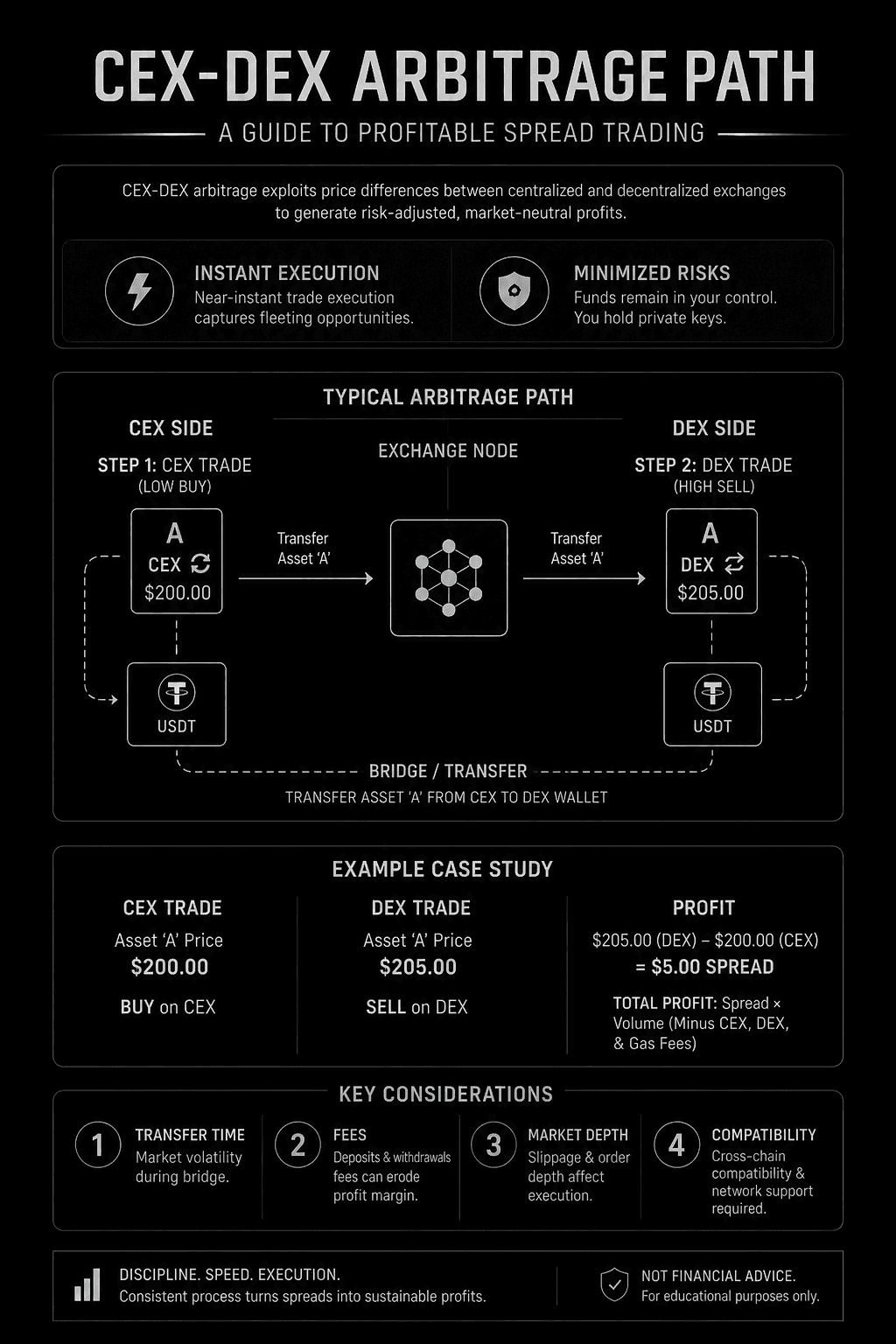
How the DEX scanner finds spreads across 20+ CEX venues
Price comparison layer
The scanner compares on-chain routes to centralized quotes from major venues, then ranks setups by spread quality instead of only raw price difference.
Execution quality layer
Liquidity, buy/sell flow, market cap, quote age, and CEX volume help remove fake spreads that collapse as soon as you try to trade them.

Transfer-style exits: validate deposit/withdraw rails and spot volume before trusting the spread.

Hedge-style setups: spread + funding + lifetime is the minimum validation set.
DEX arbitrage overview
DEX to CEX arbitrage
Buy on the cheaper DEX, move inventory or already-held inventory toward the more expensive CEX, and sell once deposit and order-book depth are confirmed. This is the most intuitive route for spot-led execution.
DEX buy plus futures short
Buy the spot token on-chain and short the richer perp or futures contract on a CEX. When the hype cools and prices converge, unwind both legs and keep the spread after gas, fees, and funding.
DEX momentum lead
Sometimes the DEX moves first because a low-float pool gets hit aggressively. If CEX price is still stale, the edge is often a fast hedge or fast exit rather than a slow transfer.
Same-chain DEX to DEX
Compare two routers or two pools on the same chain. These trades can be fast, but your slippage tolerance and route simulation need to be much tighter.
Live Example: DEX entry + CEX hedge (spot or perp)
Validate the DEX leg (liquidity + activity), then hedge or exit on a CEX while the spread compresses.
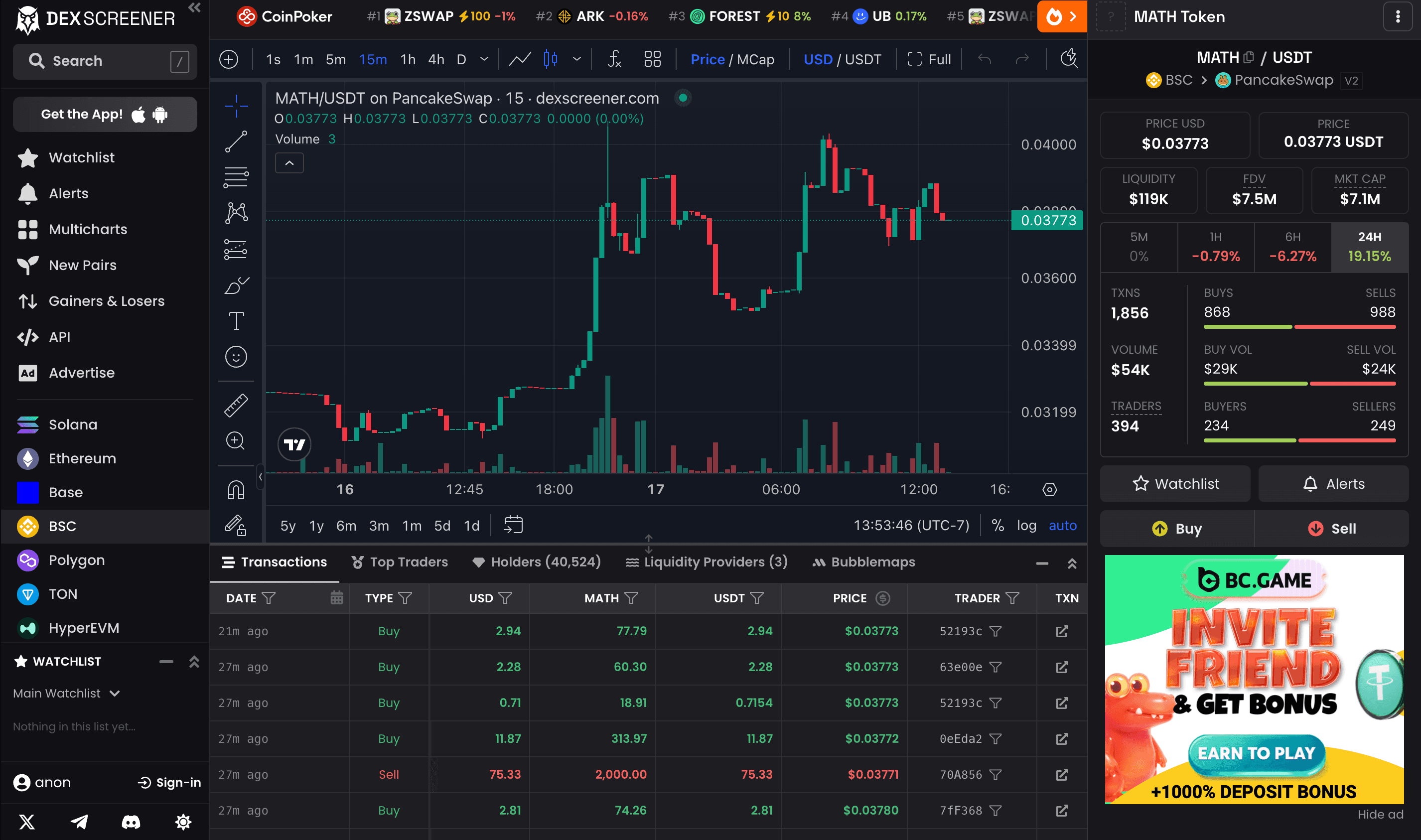
Step 1: DEX buy trigger
The DEX chart shows MATH/USDT on PancakeSwap trading around $0.03773. Before you act, confirm pool liquidity, 24h activity, and that the quote is fresh (not a thin, single-wick print).
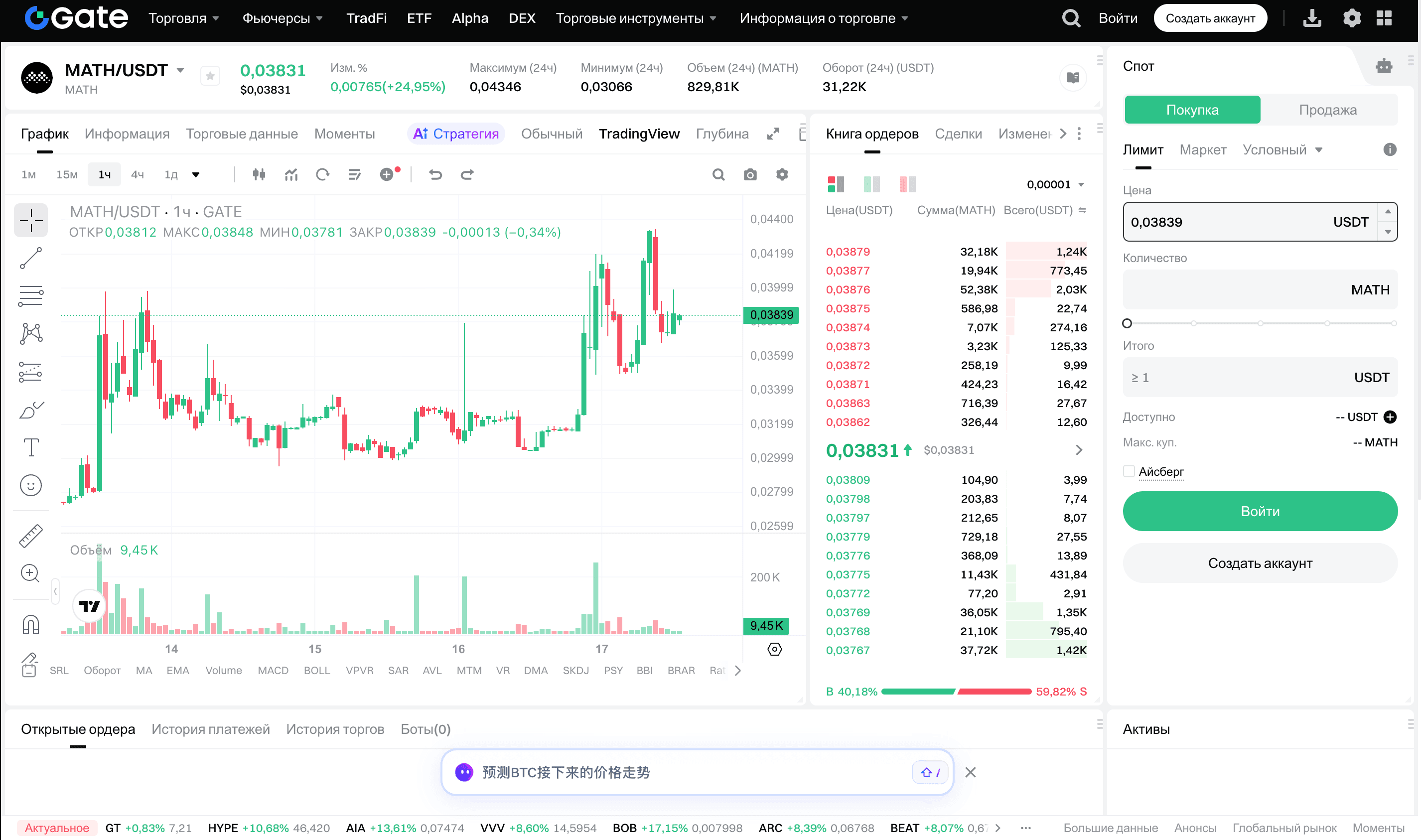
Step 2: Gate exit/hedge leg
Gate shows MATH/USDT around $0.03839. This is your rich-side validation: check order-book depth and transfer rails (if needed). If a perp is available and stays richer, you can hedge; otherwise plan a clean spot exit.
Execution summary: buy on the DEX only when liquidity and activity look real, then validate the rich CEX leg (depth + rails) and exit or hedge while the spread compresses. If liquidity thins, gas spikes, or the rich-side depth disappears, skip the setup.
DEX arbitrage strategies that traders actually use
1. DEX to CEX transfer arbitrage
Best when the DEX is clearly cheaper, withdrawal and deposit rails are open, and the token is liquid enough on the CEX to exit without killing the edge. This is slower than hedging, but easier to understand operationally.
2. DEX to futures hedge
Best when DEX spot leads and the CEX futures contract is richer. Buy on-chain, short the richer contract, then close both legs when the basis compresses. This usually beats a slow transfer in volatile names.
3. DEX momentum lead vs lagging CEX
If the pool gets hit first and CEX price has not updated yet, the opportunity is often a fast short or a quick sell into the centralized order book. These windows can be short, but they are some of the best asymmetric setups.
4. DEX to DEX same-chain spreads
Look for router mismatches across Uniswap, Curve, Balancer, Camelot, or Jupiter routes. Execution is fast, but your slippage tolerance and route simulation need to be much tighter.
Step-by-step execution checklist
Detect route imbalance
Scan chain, router, liquidity, and 24h movement to isolate spreads that still stay positive after gas and slippage.
Validate depth
Check dex buys, dex sells, pool liquidity, and market cap before committing size. Thin pools should be ignored even with a large spread.
Execute fee-aware
Use the preview route only when gas, routing cost, and quote age keep net edge positive. Requotes and stale paths kill DEX setups fast.
Track the route
Monitor whether the route is still stable. If net spread narrows, liquidity drops, or gas spikes, skip the trade and wait for a cleaner setup.
Liquidity rule
Do not size off the headline spread. Size off real exit depth, quote age, and how quickly the rich side can normalize.
Gas rule
If gas spikes enough to cut the net edge below your threshold, the setup is gone even if the raw spread still looks big.
Exit rule
Close when convergence happens, not when the chart looks exciting. Arbitrage pays on compression, not on hope.
Risk / volatility playbook for DEX spreads
When to skip
Skip if spread is old, pool depth is thin, gas jumped, or order-book depth on the rich side cannot absorb your size.
Risk filters to keep
Use min liquidity, min market cap, min buys/sells, max lifetime, and minimum CEX volume together. One filter alone is not enough.
Spot transfers: operational checks before route execution
Deposit/withdraw status
Keep deposit and withdraw checks enabled if your route depends on moving funds. A broken rail can cancel the edge instantly.
Transfer-time stop
Use a hard time-stop for transfer routes. If transfer is too slow, the spread usually converges before your exit fill.
Alertas de Telegram convenientes para arbitraje DEX
Configure notificaciones de Telegram convenientes para rutas de arbitraje DEX, coberturas y filtros de ejecución. Puede separar alertas spot basadas en transferencias de alertas futures para hedge, ajustar la frecuencia de señales y dejar solo la información útil para ejecutar en mercado real.
Alertas DEX → Spot
Configuración flexible: use `spot` para rutas con transferencia o `both` para recibir alertas spot y futures en un mismo flujo. Controle la frecuencia con `notification_interval_minutes`.
Validaciones útiles de ejecución: active los filtros de depósito y retiro disponibles para que las alertas muestren solo rutas que realmente puede mover y cerrar.
Señales más limpias: combine exchanges spot permitidos, volumen spot, límites de spread y filtros de lifetime para mantener notificaciones prácticas y no ruidosas.
Más contexto de ruta: use filtros de cadenas y pools DEX para centrarse en venues conocidos, mejor liquidez y oportunidades más repetibles.
ORAIUSDT ➠ 2.3843%╼╼╼╼╼╼╼╼╼╼╼╼╼╼╼╼╼╼╼╼╼╼╼╼╼╼╼╼╼╼╼╼╼╼╼╼╼╼╼╼╼╼╼╼╼╼⌬ MARKET• DEX Liq ➠ $7,576.14• DEX 24h % ➠ -5.33% (24h)• Market Cap ➠ $5,545,036.00• CEX Vol 24h ➠ $5,248.60• DEX TX 24h ➠ 167b / 130s• Lifetime ➠ 2152s╼╼╼╼╼╼╼╼╼╼╼╼╼╼╼╼╼╼╼╼╼╼╼⌬ TRANSFER• Network ➠ ORAI• Deposit ➠ ONLINE• Withdraw ➠ ONLINE• Fee ➠ —╼╼╼╼╼╼╼╼╼╼╼╼╼╼╼╼╼╼╼╼╼╼╼
Alertas DEX → Futures
Flujo futures separado: use `futures` para alertas solo de hedge o `both` para ejecutar los pipelines spot y futures juntos.
Control de venues: configure los exchanges de futures permitidos junto con filtros estrictos de cadenas y pools DEX para evitar mercados débiles.
Contexto completo de la señal: revise el spread junto con el volumen de futures, el funding y la vida útil de la ruta para que las señales amplias pero débiles no dominen el feed.
Menos ruido: si las alertas son demasiado frecuentes, aumente primero el spread mínimo y el volumen mínimo de futures antes de alargar el intervalo.
Qué priorizar: primero la calidad del venue, luego la profundidad de liquidez, la estabilidad del spread y las condiciones de funding.
BICOUSDT ➠ 1.4458%╼╼╼╼╼╼╼╼╼╼╼╼╼╼╼╼╼╼╼╼╼╼╼╼╼╼╼╼╼╼╼╼╼╼╼╼╼╼╼╼╼╼╼╼╼╼╼╼╼╼╼╼╼╼⌬ Liquidity ➠ $38,807.13⌬ MarketCap ➠ $33,258,781.00⌬ DEX Change ➠ 8.22% (24h)⌬ DEX Activity ➠ 580b / 489s⌬ Lifetime ➠ 84s╼╼╼╼╼╼╼╼╼╼╼╼╼╼╼╼╼╼╼╼╼╼╼╼╼╼╼⚙︎ Fut Volume ➠ $12,246,491.08⚙︎ Funding 8h ➠ -0.129639%⚙︎ Type ➠ futures_to_dex╼╼╼╼╼╼╼╼╼╼╼╼╼╼╼╼╼╼╼╼╼╼╼╼╼╼╼Chart ➠ DexScreener
Best chains and venues for DEX arbitrage
DEX → CEX Transfer
Cheaper on-chain spot, richer centralized exit. Best for clean deposits, deep order books, and patient execution after confirmation.
DEX → Futures Hedge
Buy on DEX, short the richer perpetual or futures venue. Best for hype spikes, new token momentum, and faster convergence exits.
Same-Chain DEX Spread
Route mismatch between two pools or routers on the same chain. Lower transfer friction, but much tighter slippage discipline is required.

Ethereum
ETH
Best for: Deep blue-chip pools
Strength: Largest liquidity, best major-pair depth
Works well for: DEX → CEX, same-chain majors

Arbitrum
ARB
Best for: L2 spread capture
Strength: Cheap execution, strong alt liquidity
Works well for: DEX → CEX, same-chain DEX

Optimism
OP
Best for: Route arbitrage
Strength: Low fees, clean L2 settlement
Works well for: DEX → CEX, same-chain DEX

Solana
SOL
Best for: Fast momentum dislocations
Strength: Fastest execution, tiny fees
Works well for: Momentum lead, DEX → futures

BSC
BNB
Best for: Retail flow spikes
Strength: Active meme rotation, frequent CEX lag
Works well for: DEX → futures, DEX → CEX

Base
BASE
Best for: New listing momentum
Strength: Fast retail repricing, cheap routing
Works well for: DEX → futures, DEX → CEX
Why traders use a DEX arbitrage scanner
Manual monitoring is too slow once you track multiple chains, routers, and centralized exits. A proper DEX arbitrage scanner lets you rank spreads by liquidity, flow, chain, age, and execution quality instead of chasing random candles from social media.
Use the scanner to pre-filter only the setups that still make sense after gas, slippage, and exchange fees. Then use TG Alerts for route notifications and DEX API if you want to wire DEX spreads into your own stack.
TG Alerts
DEX route notifications with custom interval and venue filters
DEX chains
DEX dexId
Allowed spot exchanges
Allowed futures exchanges
ORAIUSDT ➠ 2.3843%╼╼╼╼╼╼╼╼╼╼╼╼╼╼╼╼╼╼╼╼╼╼╼╼╼╼╼╼╼╼╼╼╼╼╼╼╼╼╼╼╼╼╼╼╼╼⌬ MARKET• DEX Liq ➠ $7,576.14• DEX 24h % ➠ -5.33% (24h)• Market Cap ➠ $5,545,036.00• CEX Vol 24h ➠ $5,248.60• DEX TX 24h ➠ 167b / 130s• Lifetime ➠ 2152s╼╼╼╼╼╼╼╼╼╼╼╼╼╼╼╼╼╼╼╼╼╼╼⌬ TRANSFER• Network ➠ ORAI• Deposit ➠ ONLINE• Withdraw ➠ ONLINE• Fee ➠ —╼╼╼╼╼╼╼╼╼╼╼╼╼╼╼╼╼╼╼╼╼╼╼
BICOUSDT ➠ 1.4458%╼╼╼╼╼╼╼╼╼╼╼╼╼╼╼╼╼╼╼╼╼╼╼╼╼╼╼╼╼╼╼╼╼╼╼╼╼╼╼╼╼╼╼╼╼╼╼╼╼╼╼╼╼╼⌬ Liquidity ➠ $38,807.13⌬ MarketCap ➠ $33,258,781.00⌬ DEX Change ➠ 8.22% (24h)⌬ DEX Activity ➠ 580b / 489s⌬ Lifetime ➠ 84s╼╼╼╼╼╼╼╼╼╼╼╼╼╼╼╼╼╼╼╼╼╼╼╼╼╼╼⚙︎ Fut Volume ➠ $12,246,491.08⚙︎ Funding 8h ➠ -0.129639%⚙︎ Type ➠ futures_to_dex╼╼╼╼╼╼╼╼╼╼╼╼╼╼╼╼╼╼╼╼╼╼╼╼╼╼╼Chart ➠ DexScreener
DEX alert matrix
What each field controls
| Bot | @crypto_arbitrage_dex_bot |
|---|---|
| Trigger | DEX price leads CEX or futures price stays richer |
| Interval | 10 min |
| Primary routes | DEX → CEX, DEX → Futures, same-chain DEX → DEX |
| Exit focus | Close on spread compression, not on emotion |
Recommended setup
- 1. Use 5-10 min for fast DEX leads.
- 2. Use 30-60 min for slower transfer routes.
- 3. Keep min spread above gas + exchange fee budget.
- 4. Prefer rich CEX exits with stable order-book depth before enabling alerts.
DEX API Documentation
Open the full documentation in a separate page for endpoint reference, payload examples, response schemas, rate limits, API key usage, and SDK examples.
View Full Documentation